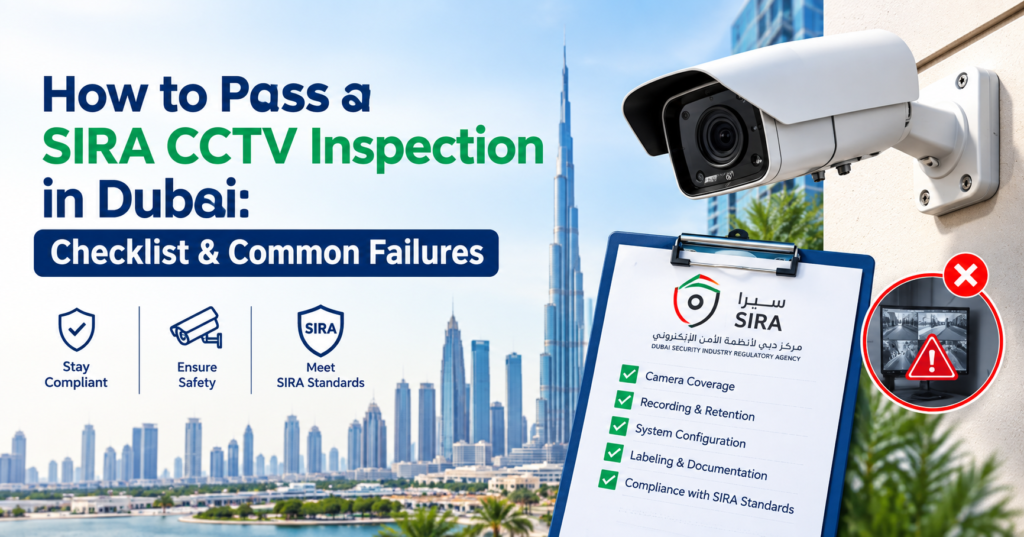
Vas Technologies— SIRA-approved CCTV installation specialists in Dubai
If your business operates on a Dubai trade license, you’ve probably already run into SIRA, the agency that decides whether your CCTV setup actually counts as “compliant.” A failed inspection isn’t just a paperwork headache either. It can hold up your license renewal, force you to rip out and redo parts of the system, and leave your premises without approved coverage while all that gets sorted.
Here’s the thing, though: SIRA doesn’t fail systems on a whim. Inspectors check for the same handful of things every single time, and almost every rejection traces back to one of a small set of predictable mistakes. Below is what they’re actually looking for, a checklist you can run through before anyone shows up, and a breakdown of the failures we see most often on site.
What SIRA actually does, and why it inspects CCTV
SIRA, the Security Industry Regulatory Agency, regulates Dubai’s entire security industry. On the CCTV side specifically, it does three things: licenses the companies allowed to sell and install security systems, sets the technical bar those systems have to clear, and audits premises, usually around license renewal or after something’s gone wrong.
If your business is open to the public a shop, restaurant, office, hotel, clinic, school, warehouse, whatever you’re almost certainly required to have a CCTV system that meets SIRA’s standards and was put in by a SIRA-licensed installer. Homes are generally exempt, though plenty of villa owners and building managers follow the same rules anyway, mostly because footage that meets the standard is footage you can actually use.
The technical detail sits in SIRA’s Preventive Systems Manual, and it goes further than most owners expect. It’s not “install some cameras and you’re done” there are rules around resolution, how the system handles glare and low light, how long footage has to be kept, how the network should be set up, and how much of a face or number plate needs to be visible depending on what the camera is watching.
Pre-Inspection Checklist
Run through each of these before you expect an inspector on site. Every item here is something they check.
1. Coverage and Camera Placement
- Entrances and exits are covered, with no blind spots right at the door.
- Cash points, tills, stockrooms, server rooms, and anywhere valuable sits are covered.
- The perimeter is covered where that applies to your property type.
- Nothing’s blocking the view: no signage, shelving, plants, or leftover renovation clutter drifting into frame.
2. Image Quality and Resolution
- Cameras hit the minimum resolution bar (1080p Full HD at minimum, though a lot of newer approvals now call for 4K/4MP in general zones and higher still at cash counters and entry points).
- Each camera is matched to the right “view class” for its area meaning it’s close and sharp enough to actually identify a face or plate, not just capture a vague moving shape. This trips up more systems than anything else: a camera can tick the megapixel box and still fail because it’s simply mounted too far back.
- Anything facing glass, windows, or direct sun has real Wide Dynamic Range (110dB or better is the common benchmark) so people don’t wash out into silhouettes.
- Night and low-light performance actually holds up after hours.
3. Storage and Retention
- Footage is kept for the required minimum, commonly 31 days, stretching to 90 for higher-security facilities.
- The storage hardware can genuinely sustain that retention at the resolution and frame rate you’re recording; this is where systems quietly fall over. Cameras fine; but footage is overwritten after two weeks because nobody did the math on drive capacity.
- There’s a UPS in place, so a power cut doesn’t just stop recording.
4. Equipment and installer status
- Cameras, recorders, and major components are all on SIRA’s approved list.
- The install (and its ongoing maintenance) was done by a SIRA-licensed company, not a general electrician or an IT contractor doing it as a side job.
- Outdoor cameras carry a proper ingress rating (IP66 is typical) Dubai heat, dust, and humidity are unforgiving on cheap housings.
5. Network and configuration
- CCTV sits on its own dedicated network, not tangled into the office Wi-Fi.
- Where it’s required, the system is integrated with SIRA’s central monitoring platform so authorities can check status or pull footage remotely.
- Every camera is actually online at inspection time an offline camera reads as a coverage gap, even if it’s usually fine.
6. Documentation
- Current trade license.
- Tenancy contract or Ejari.
- Floor plan with camera positions marked.
- CCTV layout/design plan.
- Spec sheet listing camera models and their SIRA approval status.
- Details of the SIRA-approved installer who did the work.
- Maintenance logs and any past inspection reports.
7. Ongoing maintenance
- Lenses, housings, and cabling get physically checked on a schedule; dust and corrosion build up fast here.
- Cameras haven’t drifted out of alignment since installation (a knocked camera can sit unnoticed for months).
- There’s an active maintenance contract covering regular checks, firmware updates, and hardware servicing, not just a one-time install-and-forget.
Common Reasons Systems Fail
| Failure | Why it happens | Fix |
| Coverage gaps | Cameras were positioned off general advice rather than the actual floor plan blind spots show up at doors, corners, after a fit-out change | Map coverage against the real layout, and recheck any time the space changes |
| Wrong camera for the job | An overview-style wide camera used where identification-grade detail was actually needed (till points, entry doors) | Match each camera to its required view class, not just a headline resolution number |
| Not enough retention | Storage was sized for camera count, not for actual bitrate, so footage gets overwritten early | Do the retention math against real recording bitrate, with some margin don’t trust default settings |
| Non-approved gear | Cheaper, off-list cameras or recorders used to save on cost | Confirm every piece of hardware is on SIRA’s approved list before you buy anything |
| Unlicensed installer | System went in via a general contractor or IT firm without SIRA licensing | Ask for the SIRA license number up front, before signing anything |
| Washed-out or backlit footage | Cameras facing glass or direct sun without adequate WDR | Spec WDR-rated cameras for anything facing a light source not just the outdoor units |
| Outdated paperwork | Floor plans, layout plans, or license copies never got updated after a renovation or renewal | Keep one documentation folder and update it the moment anything about the premises or license changes |
| No dedicated network / no central link | CCTV riding on shared office Wi-Fi, or never integrated with SIRA’s monitoring platform where required | Isolate the CCTV network from day one, and confirm integration requirements with your installer |
| Maintenance that never happened | System passed once, and nobody looked at it again; cameras drift, lenses fog, drives fill up | Sign a maintenance contract and actually keep records, not just of the install but of every check after it |
Getting Ready, Step by Step
- Audit what you’ve got against the checklist above: With a SIRA-licensed provider doing the audit, not just a walk-through by eye.
- Fix coverage and equipment issues first: These take the longest and often mean reworking cabling or camera positions, so give them a head start.
- Work out your retention math properly: Actual bitrate against actual storage capacity, checked against the required number of days.
- Get your documentation in one place: License, tenancy proof, floor plan, layout plan, spec sheet, installer details, all current.
- Book a pre-check with your installer: A few weeks before the real inspection or renewal, so there’s time to fix whatever turns up.
- Don’t stop after passing once: A compliant system today can drift out of spec in six months without regular checks.
Who actually needs SIRA CCTV approval in Dubai?
Pretty much any commercial premises open to the public retail, F&B, offices, hotels, healthcare, education, warehouses, industrial sites. Residential properties usually aren’t required to comply, though a lot of owners do it anyway for practical reasons.
How often does SIRA actually inspect?
Usually around license renewal, but it can also happen after a complaint, an incident, or a routine audit; there’s no fixed public calendar. Which is really the point: staying compliant year-round matters more than cramming before a known date.
What’s the minimum retention period?
31 days is the figure most commonly cited for standard commercial premises, with longer retention for higher-security facilities. Requirements do get updated from time to time, so it’s worth double-checking the current number with your installer or SIRA directly before you finalize storage sizing.
Can I just install CCTV myself and sort out approval afterward?
Technically maybe, but it’s a gamble. If the gear isn’t SIRA-approved or the installer isn’t licensed, you could end up redoing the whole thing to pass which costs a lot more than getting it right the first time.
What actually happens if I fail?
It varies, but generally you get a window to fix the issues, your license renewal may be delayed, and fines are possible. Expect a re-inspection once the fixes are in.
Does a higher-resolution camera guarantee a pass?
No. Resolution is one piece of it; inspectors also look at placement, view class, retention, network setup, and documentation. A sharp camera pointed the wrong way still fails.
How do I check if my installer is actually SIRA-licensed?
Just ask for the license number directly and verify it before signing anything. A legitimate installer will hand it over without any fuss.

Related Post
- Biometric & Access Control System Installation: What Dubai Businesses Actually Need to Know

- How to Pass a SIRA CCTV Inspection in Dubai: Checklist & Common Failures
- Essential Cybersecurity Guidelines for UAE Companies Handling Sensitive Data
- Designing a Frictionless Hybrid Meeting Room: Best AV Solutions for Teams & Zoom
- Access Control & Biometric Compliance in Dubai Workplaces: A Guide for Facility Managers
- SIRA vs. Non-SIRA Approved Systems: What Dubai Business Owners Need to Know