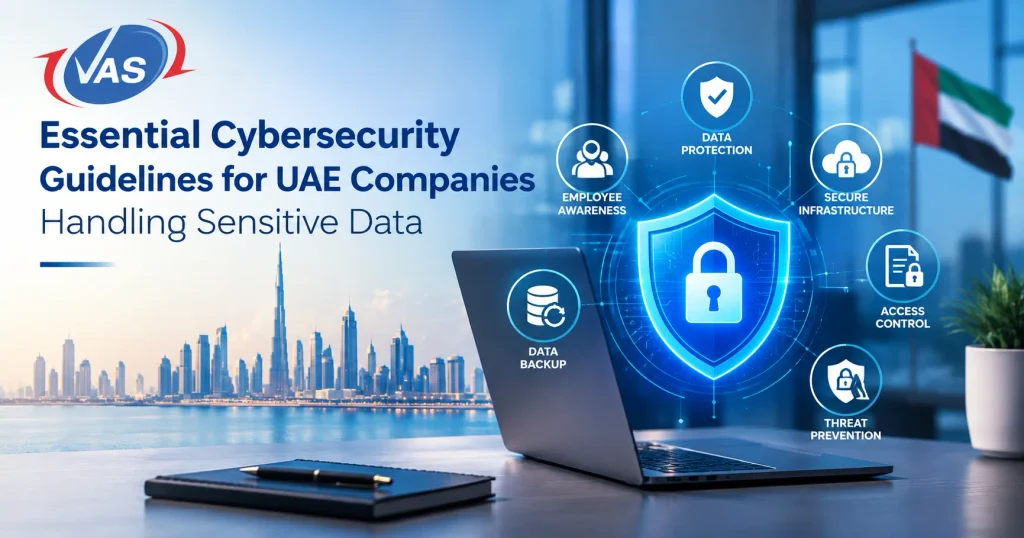
Every day, UAE companies collect, store, and process an enormous volume of sensitive information: customer identities, financial records, medical files, employee data, confidential business intelligence. As Dubai and the wider Emirates keep pushing to become a global business and technology hub, the amount of data moving through local networks is growing about as fast as the threats trying to get at it.
For business leaders, this stopped being purely an IT problem a while ago. It’s now a legal question, a financial one, and often a reputational one too. The UAE has tightened its data protection rules considerably over the past few years, and regulators now expect organizations of every size to show that sensitive data is actually protected not just sitting behind a password and called “secure.”
This guide covers the cybersecurity guidelines UAE companies handling sensitive data should be following in 2026: the regulatory backdrop, the practical guidelines themselves, and the gaps that most often turn into real breaches.
Why Cybersecurity Isn’t Optional Anymore in the UAE
The UAE is one of the more heavily targeted countries in the Middle East for cyberattacks. Part of the reason is simple: it has a dense concentration of financial services, real estate, healthcare, and government-linked entities, and those sectors sit on high-value data. Attackers have adjusted accordingly. Where opportunistic malware used to be the main concern, the bigger threats now are targeted ransomware, business email compromise, and social engineering campaigns built specifically around UAE organizations.
Regulation has caught up too. Between the Personal Data Protection Law (PDPL), sector frameworks like NESA (now sitting under the UAE Cyber Security Council) for critical infrastructure, and free zone rules such as the DIFC Data Protection Law, “we didn’t realize” doesn’t hold up as an excuse anymore.
There’s also a Dubai-specific layer to consider. Companies working in security, facilities management, and related fields often need to line up with SIRA (Security Industry Regulatory Agency) requirements as well and those increasingly touch how operational and client data gets secured, not just how a building is physically protected.
Put simply: cybersecurity guidelines have moved from “good practice” to “the price of doing business” in the UAE.
The UAE’s Data Protection Framework, Briefly
Before getting into the guidelines themselves, it’s worth knowing what’s actually shaping them.
Federal Decree-Law No. 45 of 2021, the PDPL, is the UAE’s core personal data law. It applies to most companies processing personal data on the mainland, with a few carve-outs for government bodies and certain regulated sectors. It sets out how data should be processed lawfully, requires data minimization, mandates security safeguards, and includes breach notification obligations.
Free zones run their own rules on top of that. The DIFC Data Protection Law (enforced by the DIFC Commissioner) and the ADGM Data Protection Regulations apply to companies licensed in those financial free zones, and both look a lot like GDPR in structure.
Then there are sector regulators the Central Bank of the UAE for financial institutions, the Dubai Health Authority for healthcare providers each adding their own layer of cybersecurity and data-handling requirements.
And overseeing the bigger picture, the UAE Cyber Security Council coordinates national cyber resilience strategy and has been publishing more guidance and enforcing standards more actively in recent years.
Most companies handling sensitive data end up needing to map out which of these apply to them, and it’s common for more than one to apply at once.
Core Guidelines for Handling Sensitive Data
1. Know Where Your Data Actually Is
You can’t protect data you haven’t accounted for. So the first real step in any security program is a classification exercise, figuring out exactly what sensitive data your company holds, where it’s stored (servers, cloud platforms, laptops, third-party tools), who can access it, and how it moves between systems.
Most UAE companies are surprised by how scattered their sensitive data turns out to be once they actually go looking, spread across inboxes, shared drives, CRM systems, and the odd forgotten spreadsheet someone made three years ago. Getting a proper data map together is really the foundation everything else sits on.
2. Tighten Access Controls
Not everyone in the company needs access to everything. The principle of least privilege giving people access only to what their role actually requires cuts down significantly on the damage a single compromised account can do.
A few things worth putting in place:
- Role-based access control tied to actual job function
- Multi-factor authentication on every system that touches sensitive data, no exceptions
- Periodic access reviews to strip permissions from people who’ve changed roles or left
- Privileged access management for admin-level accounts
3. Encrypt Data at Rest and in Transit
Encryption comes up directly and repeatedly across UAE data protection guidance, and for good reason. Sensitive data needs to be encrypted both while it’s sitting in storage and while it’s moving across networks, in email attachments, syncing to the cloud, wherever.
If a laptop goes missing or a database gets breached, solid encryption is often what separates a contained incident from a full-blown regulatory violation.
4. Have an Incident Response Plan Written Down
Under PDPL and most sector regulations, companies have to notify authorities and sometimes affected individuals within a set window after discovering a breach. Trying to work out what happened and who’s responsible while also drafting a regulator notification, all in the middle of an active incident, is how deadlines get missed and damage gets worse.
A workable incident response plan should spell out:
- Who’s responsible for spotting and escalating incidents
- Steps for containment and investigation
- Notification timelines and templates, both for regulators and affected people
- A process for reviewing what happened afterward
5. Don’t Ignore Vendor Risk
A lot of breaches don’t start inside a company’s own systems they come in through a vendor, contractor, or software supplier with weaker defenses. If a UAE company shares sensitive data with a payroll provider, a marketing agency, or a SaaS platform, that data is only as safe as the weakest link in that chain.
Vendor due diligence should mean actually checking a supplier’s security certifications, building data protection obligations into the contract, and limiting what’s shared to what’s genuinely necessary.
6. Train People Regularly, Not Once a Year
Human error is still the single biggest cause of data breaches, in the UAE and everywhere else. Phishing emails, weak passwords, an email sent to the wrong recipient most incidents trace back to something that ordinary, not to some elaborate hack.
A training program that actually works goes beyond a once-a-year compliance video. It includes simulated phishing tests, guidance tailored to different roles (finance faces different risks than HR), and a simple, low-friction way for people to flag something suspicious without worrying they’ll look foolish for asking.
7. Keep an Eye on the Network, Continuously
Attackers often sit inside a network for weeks, sometimes months, before anyone notices. Continuous monitoring SIEM tools, intrusion detection, regular vulnerability scans closes that gap considerably.
For companies that don’t have the resources to staff monitoring around the clock, working with a managed security services provider is usually a more realistic option than trying to build an in-house security operations center from nothing.
8. Back Things Up, and Actually Test the Backups
Ransomware is still one of the most disruptive threats UAE businesses face. A well-maintained backup strategy he 3-2-1 approach is a reasonable baseline: three copies, on two types of media, one kept offsite or in isolated cloud storage means a company can recover without paying a ransom or losing critical records for good.
The part people skip is testing. A backup that’s never been tested is really just a hope, not a plan.
9. Run Risk Assessments Regularly
Cybersecurity isn’t something you finish. Annual risk assessments, at a minimum, help catch new vulnerabilities as systems, staff, and threats all shift over time. Companies in regulated sectors, or those working toward SIRA compliance, also benefit from formal audits against frameworks like ISO 27001; it’s a clear signal of due diligence to regulators, clients, and partners.
10. Connect Physical Security and Cybersecurity
For businesses operating under SIRA and similar rules, physical and cyber security overlap more than people realize. Access control systems, surveillance equipment, building management platforms these are all connected devices now, and they can be exploited just like any other endpoint if they’re not properly secured. Treating physical security tech as part of the broader cyber risk picture, rather than a separate world entirely, matters more each year.
Where UAE Companies Tend to Slip Up
Even companies with good intentions run into the same handful of problems:
- Treating compliance as a box to tick rather than building real security capability
- Assuming attackers only go after big enterprises SMEs are often targeted for the exact opposite reason, because they’re easier to get into
- Overlooking mobile and remote work risk, even though hybrid setups are now the norm across Dubai
- Writing an incident response plan only after an incident has already happened
- Missing cloud misconfigurations, which have become one of the most common ways sensitive data ends up exposed
Putting It Together
The guidelines above work far better as one connected program than as separate one-off fixes. A reasonable order to tackle them in:
- Assess current data handling practices and figure out which regulations apply
- Classify sensitive data across all systems
- Fix the highest-priority gaps first: access controls, encryption, MFA
- Write down policies and incident response procedures
- Train staff and actually test defenses
- Monitor continuously and revisit the whole thing annually
For many UAE companies SMEs and mid-sized businesses especially, who rarely have a dedicated security team bringing in an experienced local IT and cybersecurity partner speeds this whole process up considerably. It also means someone in the room already understands PDPL, NESA, and SIRA requirements, rather than learning them from scratch.
Final Thoughts
Cybersecurity guidelines in the UAE aren’t some abstract regulatory concern anymore they shape how companies handle every piece of sensitive data they touch, day to day. Businesses that treat data protection as a genuine priority, instead of something to deal with after a scare, end up better positioned not just to avoid fines, but to earn real trust from customers, partners, and regulators in one of the most competitive markets in the world.
Vas Technologies works with businesses across Dubai and the wider UAE to assess, build, and manage cybersecurity and compliance programs suited to local regulatory requirements from PDPL alignment to SIRA-related security infrastructure. If your organization is ready to take a closer look at how it protects sensitive data, get in touch with our team for a tailored security assessment.
Frequently Asked Questions
1. What are the main cybersecurity laws UAE companies need to follow?
The core law is Federal Decree-Law No. 45 of 2021, the PDPL, which governs personal data processing across mainland UAE. Companies in financial free zones also need to comply with DIFC or ADGM data protection rules, and certain sectors face additional requirements from regulators like the Central Bank of the UAE or Dubai Health Authority.
2. Does the PDPL apply to all businesses in the UAE?
It applies broadly to entities processing personal data on the mainland, though there are exemptions for government bodies and some already-regulated sectors like parts of finance and healthcare. It’s worth confirming your specific obligations based on sector and location rather than assuming.
3. What counts as “sensitive data” under UAE regulations?
Personal identifiers, financial records, health information, and biometric data are the usual categories, plus anything that could cause harm or discrimination if it got out. It’s also worth treating commercially sensitive material trade secrets, client contracts with the same level of care, even where the law doesn’t strictly require it.
4. What happens if a UAE company experiences a data breach?
Depending on which law applies, companies generally have to notify regulators and sometimes affected individuals within a set timeframe after finding out about a breach. Non-compliance can mean significant fines, and the reputational fallout is often worse than the financial penalty.
5. How often should a UAE company update its cybersecurity policies?
At least once a year, and sooner if something changes new regulations, a security incident, new technology being adopted, or a restructuring.
6. Is multi-factor authentication legally required in the UAE?
Not always by name in every regulation, but it’s generally treated as part of the “appropriate technical and organizational measures” that regulators expect, and it’s considered standard practice regardless.
7. What is SIRA and how does it relate to cybersecurity?
SIRA, the Security Industry Regulatory Agency, oversees security services and technology in Dubai. It started out focused on physical security, but its reach now overlaps with cybersecurity as surveillance and access control systems become connected devices in their own right.
8. Should small and medium businesses in the UAE worry about cybersecurity as much as large enterprises?
Yes, arguably more so in practice SMEs are often targeted precisely because their defenses tend to be weaker, while they still hold valuable customer and financial data. Sometimes they’re also used as a way in to a larger partner organization.
9. How can a UAE company start improving its cybersecurity without a large budget?
Turning on MFA everywhere, doing a basic data classification pass, training staff to spot phishing, and making sure backups exist and actually work none of that costs much, and together it addresses a large share of how breaches actually happen.
10. Should UAE companies hire an in-house security team or outsource to a provider?
It depends on size, budget, and how much risk the business is carrying. For many mid-sized UAE companies, a managed cybersecurity provider ends up being the more practical route specialist expertise and round-the-clock monitoring, without the cost of building an equivalent team internally.

Related Post
- Cloud Backup for Dubai Businesses: What Happens If Your Server Dies?

- Office Fit-Out Technology Guide: Network, Phones, AV and CCTV
- SIRA CCTV Approval in Dubai: Cost, Steps and Timeline for Restaurants, Shops and Warehouses
- Biometric & Access Control System Installation: What Dubai Businesses Actually Need to Know
- How to Pass a SIRA CCTV Inspection in Dubai: Checklist & Common Failures
- Essential Cybersecurity Guidelines for UAE Companies Handling Sensitive Data