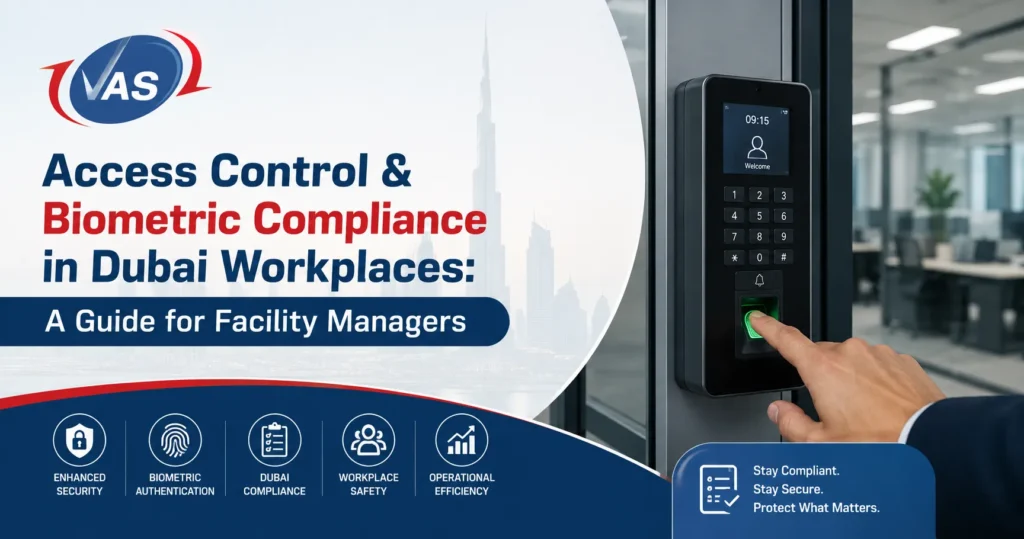
Walk into most modern office buildings in Dubai now, and you’ll see the same thing: a fingerprint scanner at the entrance, a facial recognition camera on the turnstile, maybe a palm-vein reader guarding the server room. Biometric access control has quietly become the default, not the upgrade. But there’s something a lot of facility managers don’t think about until it’s a problem: biometric data isn’t treated like ordinary data in the UAE. It’s classified as sensitive personal data, and that classification comes with real obligations. Get it wrong, and you’re not just looking at an awkward IT conversation. You’re looking at regulatory exposure.
So here’s the practical version: what facility managers in Dubai actually need to understand to run a system that’s both secure and compliant.
Why Everyone’s Moving to Biometrics
Key cards and PINs have always had the same problem. They get lost. They get shared. Someone leaves the company and forgets to hand theirs back. A fingerprint or a face doesn’t have that issue; you can’t lend it to a colleague who forgot their badge.
That’s the headline reason facilities switched, but it’s not the only one. A few things tend to matter most once a system is actually running:
No more buddy-punching. Access is tied to a physical identifier, so one person can’t clock in for another.
Time and attendance basically manages itself; entry and exit get logged automatically, no timesheets required.
You get a real audit trail. If something goes wrong, you know exactly who was where and when.
Entry is faster, especially with contactless options like facial or palm-vein recognition, which also happen to suit the hygiene expectations that stuck around after the pandemic.
None of that comes free, though. What you’ve gained in convenience, you’ve taken on in responsibility; you’re now storing something far more personal than a badge number. And that’s precisely why compliance around it matters so much.
What Facility Managers Actually Need to Know
A few points matter more than the rest if you’re the one signing off on an access control system
Biometric data gets the “sensitive” label. Biometric data used for identification is treated as sensitive personal data in the UAE, in the same category as health data, genetic data, and religious beliefs. Processing it usually requires explicit consent as the lawful basis, and it triggers stricter security requirements plus the need for a proper data protection impact assessment. In plain terms: you can’t just install the scanners and roll it out. There’s a paperwork step first, and it’s not optional.
It covers your staff, not just your visitors or customers. This is where a lot of facility managers get caught out, because the instinct is to think of data protection obligations as a customer-data issue. It isn’t. Employee personal data is fully covered, which means employers need a lawful basis for processing it, have to give staff a privacy notice at onboarding, need a retention policy for employee records, and must respond to data access requests within a reasonable timeframe. If your fingerprint scanner is logging when your facilities team clocks in, that log is personal data, and it’s their data, with rights attached.
Free zones complicate things. Data protection obligations aren’t uniform across the UAE; different zones can run their own frameworks alongside the wider federal rules, so the requirements depend on where your building actually sits. If your facility is in a free zone, don’t assume the standard federal rules are the only ones you need to check.
And this isn’t something sitting quietly on the books. Data protection obligations in the UAE are actively enforced. Which means biometric access control has quietly shifted from an IT install-and-forget project into something that needs ongoing attention, the same way fire safety or insurance does.
Turning the Rules Into Daily Practice
None of this is complicated once you break it into habits; it’s more about discipline than difficulty.
Start with consent that actually means something. People should know, plainly, that their biometric data is being collected, why, how long it sticks around, and who can see it. Burying that in page 34 of the HR handbook doesn’t count.
Lock down who can access the data internally; treat biometric templates and access logs the way you’d treat payroll records, not a visitor sign-in sheet. Encrypt everything, in storage and in transit; a template sitting as a plain file on a local server is a breach waiting to happen.
Set a retention policy and actually follow it. There’s no good reason to still be holding a former employee’s fingerprint data two years after they left. Build deletion into the offboarding checklist so it doesn’t rely on someone remembering.
Document your lawful basis, and run an impact assessment where it’s called for. It sounds like bureaucracy, but for sensitive data like biometrics, it’s the difference between compliant and exposed. And have an actual incident response plan, not a vague intention to “figure it out if something happens,” but a real, written process for if biometric data is compromised.
Picking the Right Technology
Not every biometric option fits every building. Fingerprint readers are the cheapest and most familiar, but they need physical contact. Facial recognition is fast and touchless, which makes it a natural fit for busy lobbies. Palm-vein readers are the quiet overachiever: hygienic, contactless, and hard to spoof, even with things like lotion or minor cuts on someone’s hand.
Which one you pick comes down to your building, your foot traffic, and how much weight you put on hygiene versus cost. But whatever you choose, the compliance groundwork doesn’t change: consent, encryption, retention, restricted access. The technology is just the delivery mechanism. The obligations stay the same underneath it.
Where VAS Technologies Fits In
This is the exact gap VAS Technologies (vas.ae) was built to close for facility managers across Dubai and the wider UAE. They’re a Dubai-based ELV security specialist that designs, supplies, and installs biometric access control systems — fingerprint, facial recognition, palm-vein — built on platforms like Suprema and ZKTeco, and sized to whatever building you’re actually running.
The value isn’t only the hardware. It’s the on-the-ground expertise that keeps a rollout from becoming a liability: sound system architecture, integration with your time and attendance setup, configurations that scale from a single door to a full enterprise network, and support that keeps pace as your compliance obligations evolve. If you’re planning a new biometric access control system in Dubai, or auditing one you already have, it’s worth talking to someone like VAS before the hardware goes in the wall, not after.
Is biometric data actually “personal data” in the UAE?
Yes, and it’s a step above ordinary personal data. It’s classified as sensitive personal data, which comes with stricter rules than something like a name or phone number would.
Do we need employee consent to use fingerprint or facial recognition for office access?
In almost every case, yes. Sensitive personal data like biometrics generally requires explicit consent as the lawful basis, along with a clear notice telling people what’s being collected and why.
Does the same set of rules apply if our building is in a free zone like DIFC?
It depends on the zone. Some free zones run their own separate data protection frameworks alongside the wider federal rules, so you may need to work out which one applies to you or whether both do.
How long can we keep biometric access logs for someone who’s left the company?
There’s no single fixed number, but you’re expected to have a defined retention policy and actually delete the data once it’s no longer needed, ideally as a built-in step of offboarding.
What actually happens if a facility isn’t compliant?
Data protection obligations in the UAE are actively enforced, not nominal. Non-compliance can mean real regulatory penalties, not just a bad look if something leaks. It’s worth keeping your policies current as expectations evolve.
Is one biometric method more “compliant” than another — facial vs. fingerprint, say?
Not really. Compliance comes down to how you handle consent, storage, encryption, and retention, not which biometric method you chose. Every modality counts as sensitive data.
Can VAS Technologies help with both the installation and the compliance side?
Yes, VAS designs and installs biometric access control systems across Dubai and the UAE, with setups built around your building’s security needs and how you’ll actually be handling the data day to day.

Related Post
- SIRA CCTV Approval in Dubai: Cost, Steps and Timeline for Restaurants, Shops and Warehouses

- Biometric & Access Control System Installation: What Dubai Businesses Actually Need to Know
- How to Pass a SIRA CCTV Inspection in Dubai: Checklist & Common Failures
- Essential Cybersecurity Guidelines for UAE Companies Handling Sensitive Data
- Designing a Frictionless Hybrid Meeting Room: Best AV Solutions for Teams & Zoom
- Access Control & Biometric Compliance in Dubai Workplaces: A Guide for Facility Managers