If you run a business in Dubai an office, a clinic, a jewelry shop, a warehouse full of stock you’d rather not lose a lock and key just doesn’t cut it anymore. Biometric and access control systems have gone from “nice upgrade” to something close to standard practice, and in a lot of cases, they’re not optional at all. They’re the law.
This guide walks through what’s actually required, why the rules exist, and how to install a system that won’t get flagged the moment an inspector walks in.
Why biometrics, specifically?
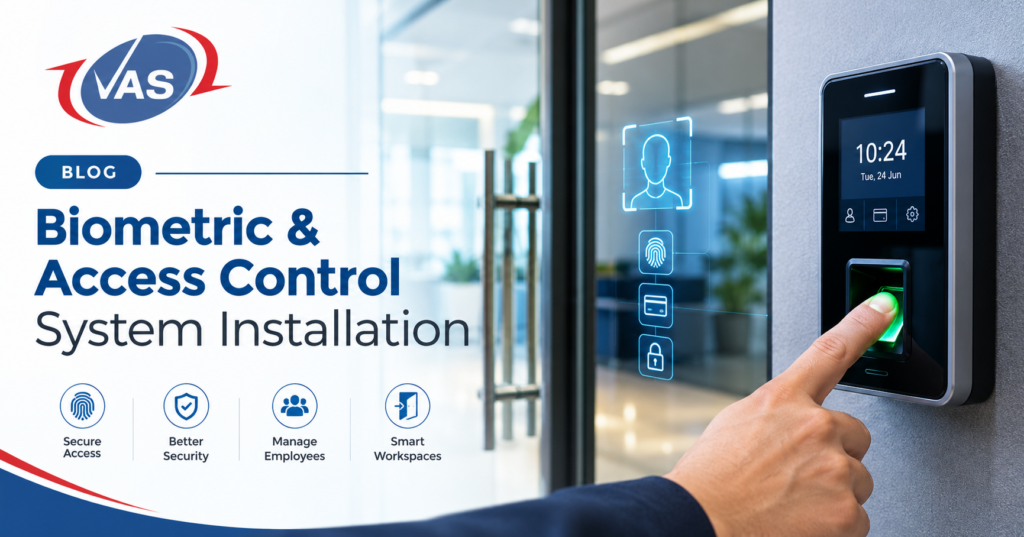
Keys get copied. Cards get lent to a coworker “just for five minutes.” PINs get written on sticky notes. Biometric systems fingerprint, facial recognition, iris scanning sidestep all of that because the thing being checked is you, not something you’re carrying. You can’t hand your fingerprint to someone else the way you’d hand them a keycard.
For a business, that means:
- Server rooms, vaults, and pharmacy storage stay genuinely restricted
- Attendance tracking gets more accurate, which matters for payroll and labor records
- There’s an actual log of who went where and when
- Insurers tend to look more favorably on documented access control
Dubai has been leaning into this for years now banking, healthcare, aviation, retail- all pushing biometric adoption harder, partly because of the sheer volume of people moving through the city day to day. This isn’t a trend that’s going to reverse.
The Part Nobody Can Skip: SIRA
Here’s the thing most business owners don’t realize until they’re mid-installation: security systems in Dubai, access control included, fall under SIRA the Security Industry Regulatory Agency, which sits under Dubai Police. And SIRA doesn’t do exceptions.
A few things that trip people up:
You need a SIRA-registered installer. Not just any IT company that says they can “handle it.” If the installer isn’t registered, the system won’t pass inspection full stop, regardless of how good the equipment is.
The equipment itself has to be SIRA-approved. This is where a lot of businesses lose money buying hardware online because it’s cheaper, only to find out it doesn’t meet certification and has to be ripped out and replaced.
You’ll need layout documentation. Camera positions, access points, coverage areas, storage plans. SIRA wants to see this on paper before approving anything. It’s not a rubber-stamp step.
Size doesn’t matter. A five-person startup and a national bank are held to the same rule: no valid SIRA approval, no legal operation. There’s no small-business pass here.
Requirements shift by industry. A clinic needs biometric or RFID-controlled access to medical storage and IT rooms, plus 90 days of video retention. A jewelry business needs biometric or PIN-controlled vaults and SIRA-certified guards on top of that. Hotels, malls, and warehouses each has its own version of the checklist depending on risk level.
And increasingly, cybersecurity is part of the deal too. Most biometric systems now run on your business network, which means they’re not just a door lock anymore; they’re an IT asset that needs protecting like one.
How This Actually Plays Out, Step by Step
- Figure out what actually needs restricting. A data center and a retail floor don’t have the same risk profile; map your restricted zones first.
- Pick the right method. Fingerprint, facial recognition, or a mix with card/PIN depends on staff numbers, hygiene concerns, and how sensitive the area is.
- Find a SIRA-registered integrator and actually verify it. Don’t take their word for it; check.
- Get the documentation sorted before installation, not after.
- Use approved hardware only, and make sure it doesn’t interfere with fire exits or emergency egress.
- Connect it with your existing CCTV and alarm setup rather than running three disconnected systems.
- Go through testing and SIRA inspection approval isn’t automatic just because the system works.
- Keep maintaining it. SIRA compliance isn’t a one-time checkbox.
Where VAS Technologies Fits In
This is the part where a lot of businesses realize they need a partner, not just a vendor. VAS Technologies is a Dubai-based company working across data networking, IT, voice, and security and access control installation sits squarely inside that.
A few reasons that combination matters in practice:
- They handle the whole process, from figuring out what your space actually needs to installing and configuring it; you’re not left guessing at specs.
- Because they also work in networking and IT, your access control system gets built with network security baked in, not tacked on afterward.
- Systems get designed around your actual risk points, not a one-size-fits-all template.
- Ongoing maintenance firmware, database upkeep, hardware servicing is part of the relationship, not an afterthought you have to chase down separately.
- One vendor for networking, IT, and security means no finger-pointing between three different companies when something goes wrong.
If you’re planning an install or an upgrade, working with someone who understands both the physical hardware and the network it sits on saves you from expensive rework down the line.
Does every business in Dubai need SIRA approval?
Not every business but if you’re installing CCTV, access control, or alarms, or you’re in a security-sensitive sector, yes. There’s no size-based exemption, so even a small office with a restricted server room should check where it stands.
Can I just hire a regular IT company to install this?
No. It has to be a SIRA-registered installer using SIRA-approved equipment, or it won’t clear inspection no matter how competent the installer is otherwise.
How long does approval usually take?
It depends on project complexity and how ready your documentation is. A good integrator who already knows what SIRA expects will move this along faster than one figuring it out as they go.
What’s actually different about biometric vs. card-based access?
Cards and PINs rely on something you’re holding or something you know both can be lost or shared. Biometrics check something that’s just… you. Much harder to bypass.
Does the system need to be online?
Most modern setups are network-connected for remote monitoring and HR integration, which is convenient but it also means the system needs the same cybersecurity attention as any other networked device.
How often does it need servicing?
At least once a year for firmware and hardware checks more often for high-traffic sites where a failure at the door is a real operational problem.
Can one company handle both the network side and the security side?
Yes, and it’s usually the smarter route. VAS Technologies, for example, covers both, so the access control system is integrated with your infrastructure from the start rather than bolted on separately.

Related Post
- Biometric & Access Control System Installation: What Dubai Businesses Actually Need to Know

- How to Pass a SIRA CCTV Inspection in Dubai: Checklist & Common Failures
- Essential Cybersecurity Guidelines for UAE Companies Handling Sensitive Data
- Designing a Frictionless Hybrid Meeting Room: Best AV Solutions for Teams & Zoom
- Access Control & Biometric Compliance in Dubai Workplaces: A Guide for Facility Managers
- SIRA vs. Non-SIRA Approved Systems: What Dubai Business Owners Need to Know